

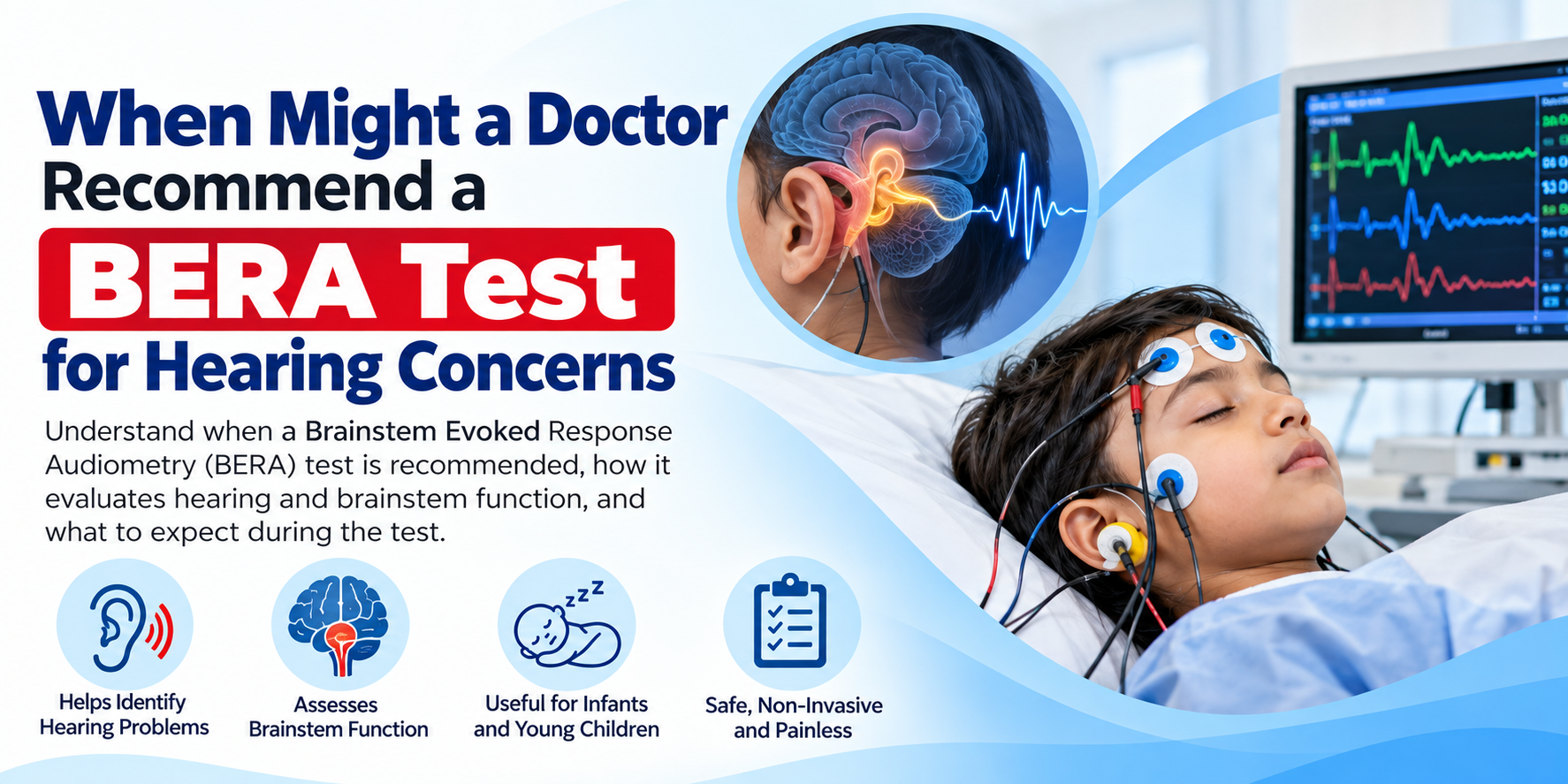
Hearing plays an important role in communication, speech development, learning, and everyday activities. When a person experiences hearing difficulties or shows signs of delayed auditory development, a doctor may recommend specialised hearing investigations to understand the underlying problem. One such investigation is the BERA test (Brainstem Evoked Response Audiometry), which evaluates how sound signals travel from the auditory nerve to the brainstem.
People searching for a BERA Test near me may be looking for a reliable diagnostic centre where they can undergo hearing assessment after a doctor’s recommendation. Understanding when this test is required, how it works, and what to expect can help patients and parents prepare for the procedure.
What Is a BERA Test?
The BERA test is a non-invasive hearing investigation that measures the electrical responses generated by the auditory pathway after sound stimuli are delivered through headphones or earphones. Small electrodes placed on the scalp and near the ears record these responses.
Unlike conventional hearing tests that often depend on a person’s ability to respond to sounds, BERA can assess auditory pathway responses without requiring the patient to provide a verbal response. This makes it particularly useful for infants, young children, and individuals who may have difficulty participating in standard hearing assessments.
BERA is also known as Auditory Brainstem Response (ABR) testing. Doctors may recommend it when additional information about hearing function or the auditory nerve pathway is needed.
When Might a Doctor Recommend a BERA Test?
A doctor may recommend a BERA test for several reasons, depending on the patient’s age, symptoms, medical history, and previous hearing assessments.
1. Suspected Hearing Loss in Infants
Early identification of hearing difficulties is important for speech, language, and communication development. If a newborn does not pass a hearing screening or has risk factors for hearing loss, further assessment may be recommended.
A BERA test can help evaluate hearing responses in infants who are too young to complete conventional hearing tests reliably. Early assessment allows healthcare professionals to determine whether further investigations or hearing support may be necessary.
2. Delayed Speech and Language Development
Children who do not develop speech and language skills as expected may require a hearing assessment. Hearing difficulties can affect a child’s ability to recognise sounds, understand spoken words, and develop communication skills.
A paediatrician, ENT specialist, or audiologist may recommend BERA testing when hearing loss is suspected or when initial hearing assessments do not provide sufficient information.
However, delayed speech can have several causes, so hearing assessment may form only one part of a broader evaluation.
3. Unclear Results From Routine Hearing Tests
Some patients, particularly young children or individuals who cannot consistently respond during testing, may not obtain reliable results from standard behavioural hearing assessments.
In these situations, BERA can provide objective information about the auditory pathway’s response to sound. The doctor may use the findings alongside other hearing tests to develop a more complete understanding of the patient’s hearing function.
4. Suspected Auditory Nerve or Brainstem Problems
Sound signals travel from the inner ear through the auditory nerve to the brainstem, where early stages of auditory processing occur.
BERA records responses along this pathway and can help clinicians investigate certain neurological or auditory abnormalities. The test may be recommended when symptoms, medical history, or other findings raise concerns about auditory nerve function.
It does not independently diagnose every neurological condition, and further investigations may be required depending on the results.
5. Hearing Concerns in Children With Developmental Conditions
Children with certain developmental conditions or medical histories may need more detailed hearing evaluations. Some may find it difficult to communicate their hearing experiences or participate in conventional tests.
BERA can help assess auditory responses objectively when clinically appropriate. The decision to perform the test depends on the child’s individual needs and the assessment recommended by the healthcare professional.
6. Monitoring Hearing After Certain Medical Conditions or Treatments
Some medical conditions and treatments can affect hearing. Depending on the clinical situation, a doctor may recommend BERA as part of a hearing evaluation or monitoring plan.
The test may be considered when there are concerns about auditory nerve function or when reliable behavioural responses cannot be obtained. Other investigations may be more suitable in some cases.
What Symptoms May Lead to a BERA Test?
A doctor may consider further hearing assessment if a child or adult experiences signs such as:
-
Not responding consistently to sounds or their name.
-
Difficulty recognising spoken instructions.
-
Delayed speech or language development in children.
-
Not passing a newborn hearing screening.
-
Suspected hearing loss despite unclear routine test results.
-
Concerns about auditory nerve function based on medical history.
These signs do not necessarily mean that a BERA test is required. A healthcare professional can determine the appropriate investigation after reviewing the symptoms and previous assessments.
How Is the BERA Test Performed?
The BERA test is generally painless and does not require surgery. The exact procedure may vary depending on the patient’s age and the diagnostic protocol.
Step 1: Initial assessment
The healthcare professional may review the patient’s symptoms, medical history, and previous hearing reports. Additional hearing examinations may be performed if required.
Step 2: Electrode placement
Small recording electrodes are attached to the scalp and areas near the ears using suitable sensors. These electrodes record electrical responses generated by the auditory pathway.
Step 3: Sound stimulation
Sounds or clicks are delivered through earphones. The electrodes detect the brainstem’s electrical responses to these stimuli.
Step 4: Recording and analysis
The equipment records and displays the responses. The specialist evaluates the waveforms and other measurements to assess the auditory pathway’s response to sound.
Step 5: Reporting
The results are interpreted alongside the patient’s clinical history and other hearing assessments. The doctor may recommend further tests, hearing support, or specialist consultation depending on the findings.
How Should You Prepare for a BERA Test?
Preparation depends on the patient’s age and the centre’s testing protocol.
For infants and young children, the test is often easier to perform when they are naturally asleep or resting quietly because movement can interfere with recordings. Parents should follow the centre’s instructions regarding feeding, sleep schedules, and arrival time.
For adults and older children, the centre may advise them to arrive with clean hair and avoid hair products that could interfere with electrode contact.
Before the appointment, consider these points:
-
Bring previous hearing test reports and the doctor’s referral, if available.
-
Inform the healthcare professional about relevant medical conditions and medicines.
-
Follow the centre’s instructions for infants and children.
-
Ask whether any special preparation is required.
-
Confirm the expected test duration and report collection process.
Do not give a child sedatives or sleep-inducing medicines unless specifically prescribed and supervised by an appropriate healthcare professional.
What Is the BERA Test Price in Delhi?
The BERA Test price in Delhi may vary depending on the diagnostic centre, the type of assessment, the patient’s age, and whether one or both ears need to be evaluated. Additional services or specialised testing protocols may also affect the total cost.
Before booking an appointment, patients should confirm the current price directly with the diagnostic centre.
When comparing prices, ask whether the quoted amount includes:
-
The complete BERA or ABR assessment.
-
Testing of one ear or both ears, as applicable.
-
Interpretation of the recorded responses.
-
The final report.
-
Any additional assessment recommended by the specialist.
Choosing a centre based only on the lowest advertised price may not provide enough information to assess the overall service. Patients should also consider the availability of appropriate equipment, qualified professionals, and clear reporting arrangements.
How to Find a BERA Test Near Me
If you are searching for a BERA Test near me, consider the following factors before choosing a diagnostic centre.
Check test availability: Confirm that the centre performs BERA or ABR testing and can accommodate the patient’s age and clinical requirements.
Ask about the testing process: Find out how long the appointment may take, whether the patient needs to sleep during testing, and what preparation is recommended.
Confirm the reporting process: Ask who interprets the results and when the report will be available.
Review appointment arrangements: For infants and young children, suitable appointment timing may help make the procedure easier.
Discuss the test with your doctor: A paediatrician, ENT specialist, or audiologist can help determine whether BERA is the most appropriate hearing investigation.
Patients in Delhi can contact local diagnostic centres to confirm availability, appointment timings, and the current BERA Test price before visiting.
What Do BERA Test Results Mean?
BERA results are based on the electrical responses recorded after sound stimulation. The specialist evaluates characteristics such as waveform patterns and response timing to determine whether the recorded findings are consistent with the expected auditory pathway response.
Depending on the findings, the report may indicate the need for additional hearing assessments or specialist evaluation.
An abnormal or unclear result does not automatically establish a specific diagnosis. Results should be interpreted in the context of the patient’s medical history, examination, and other investigations.
BERA also does not replace every other hearing test. Depending on the clinical question, a doctor may recommend additional assessments to estimate hearing thresholds, examine middle-ear function, or evaluate other aspects of hearing.
Why Is Early Hearing Assessment Important?
Early identification of hearing difficulties can help families and healthcare professionals make timely decisions about communication support and further care.
For infants and young children, appropriate hearing assessment may help identify difficulties that could affect speech and language development. For older children and adults, timely evaluation can help investigate changes in hearing and guide further management.
If you have concerns about hearing, speech development, or a failed hearing screening, consult a qualified healthcare professional rather than waiting for symptoms to resolve on their own.
Conclusion
A BERA test may be recommended when a doctor needs objective information about hearing responses, particularly in infants, young children, or patients who cannot reliably complete conventional hearing tests. It can also support the investigation of selected auditory nerve and brainstem concerns.
If you are looking for a BERA Test near me or want to know the BERA Test price in Delhi, contact a diagnostic centre to confirm availability, preparation requirements, current charges, and reporting arrangements. Your doctor can help determine whether BERA is suitable for your symptoms or your child’s hearing needs.
Frequently Asked Questions
1. Is the BERA test painful?
No. BERA is generally painless. Small electrodes are placed on the skin, and sounds are delivered through earphones to record auditory responses.
2. Can a newborn undergo a BERA test?
Yes. BERA can be used to assess hearing in newborns and infants when recommended by a healthcare professional.
3. How long does a BERA test take?
The duration varies with the testing protocol, the patient’s age, and how easily reliable recordings can be obtained. Ask the diagnostic centre for an estimate before booking.
4. What is the BERA Test price in Delhi?
The price varies between diagnostic centres and depends on the assessment required. Contact the centre directly for current charges and confirm whether reporting and any additional services are included.
5. Do I need a prescription for a BERA test?
Requirements vary by centre. A doctor’s referral can help ensure the test is appropriate and that the results address the clinical concern.
6. Is BERA the same as ABR?
BERA and ABR generally refer to the same type of auditory brainstem response assessment, although terminology and testing protocols may vary between facilities.
7. Where can I find a BERA Test near me?
Search for diagnostic centres offering BERA or ABR testing in your area. Confirm availability, preparation instructions, professional reporting, and the current price before scheduling your appointment.